
SILK LOFTS

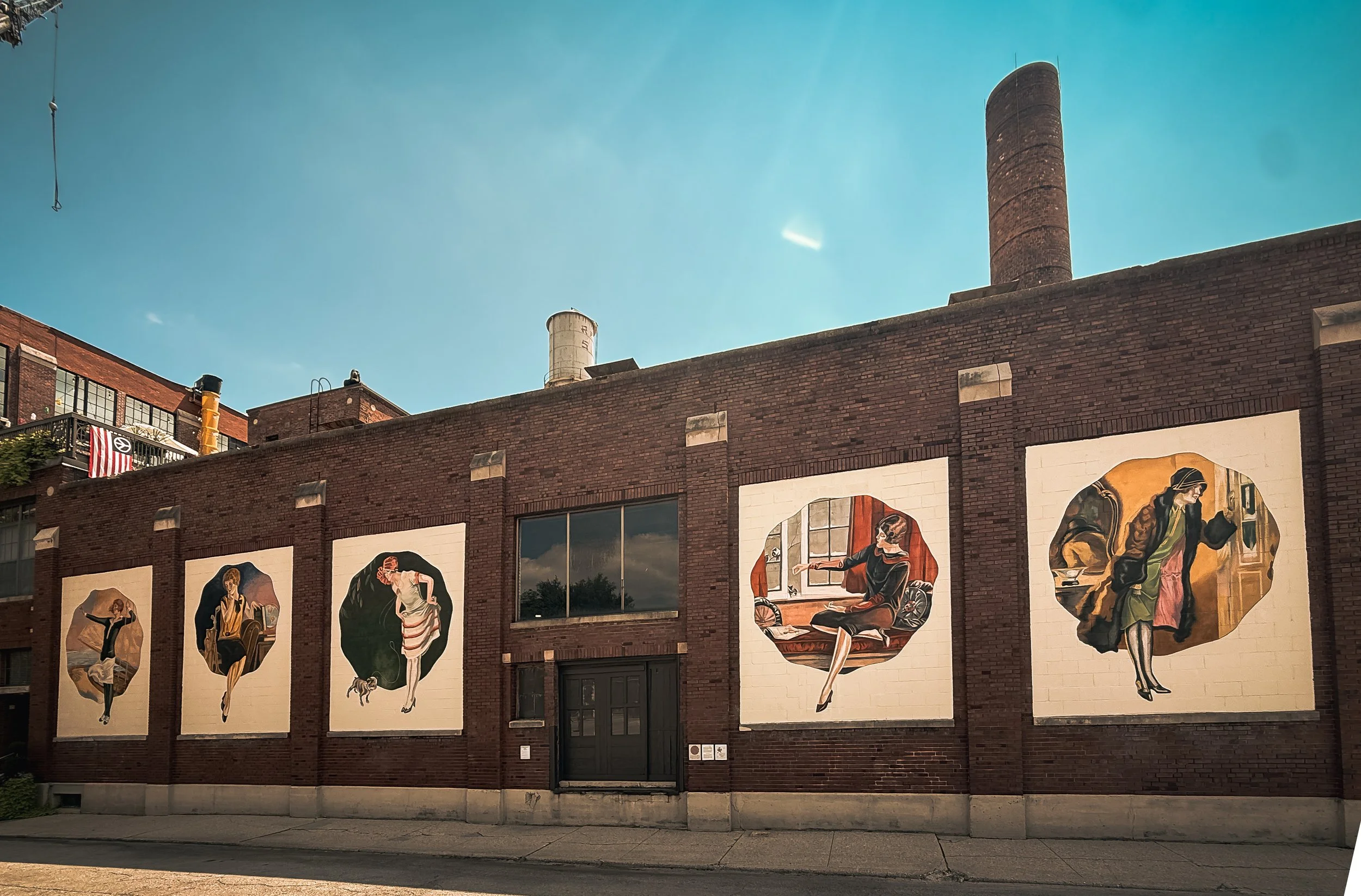
Five advertisements from the 1920s, remade at architectural scale as murals at Silk Lofts in Indianapolis

Indianapolis, Indiana
Exterior mural installation
Five painted façade panels
2026

Real Silk Hosiery Mills
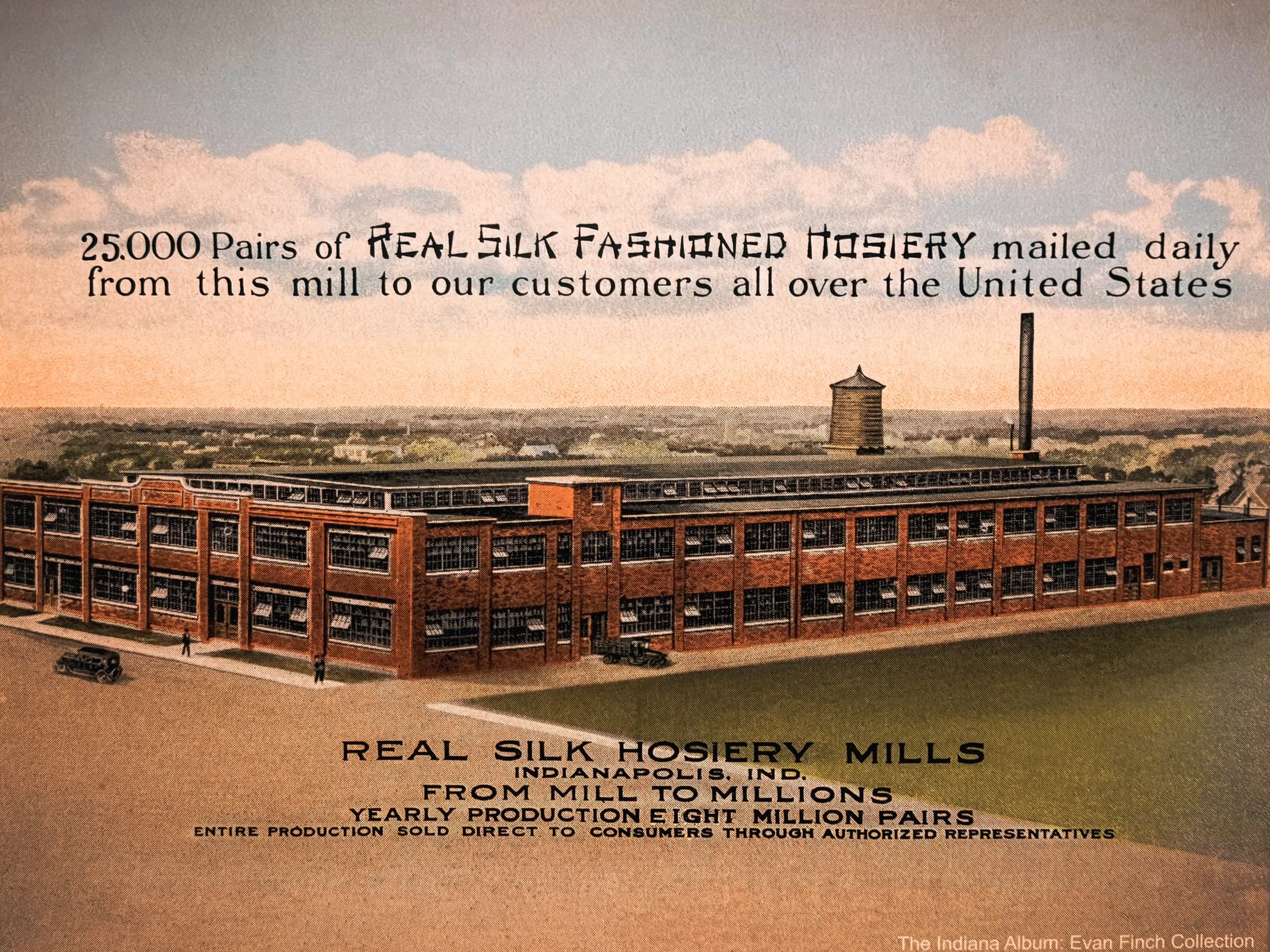
A vintage advertisement poster for a silk hosiery mill in Indianapolis, Indiana, showcasing the company's production of 25,000 pairs daily from a mill to customers nationwide, indicating early high-volume production.

Real Silk Hosiery Mills began operating in 1922 and grew into a six-acre manufacturing complex—one of the country’s largest producers of women’s silk hosiery.
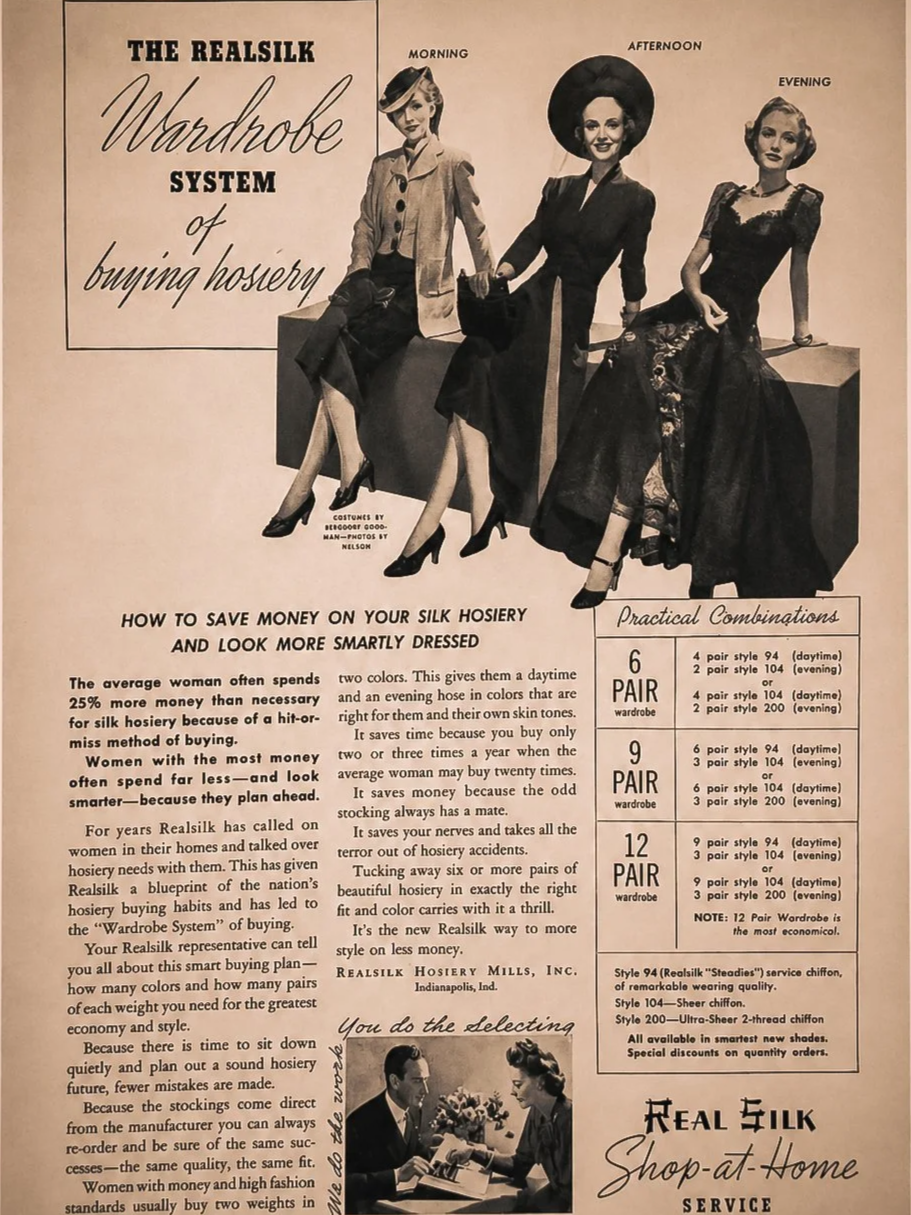
Vintage advertisement for the Realsilk Wardrobe System of buying hosiery, displaying women in different fashionable outfits labeled morning, afternoon, and evening, with a detail about hosiery matching, and instructions for saving money on silk hosiery.

At its peak, the company produced more than twelve million pairs annually. Manufacturing ended in the 1950s; after serving as the Printing Arts Center, the complex was converted to residential use and became Real Silk Lofts.
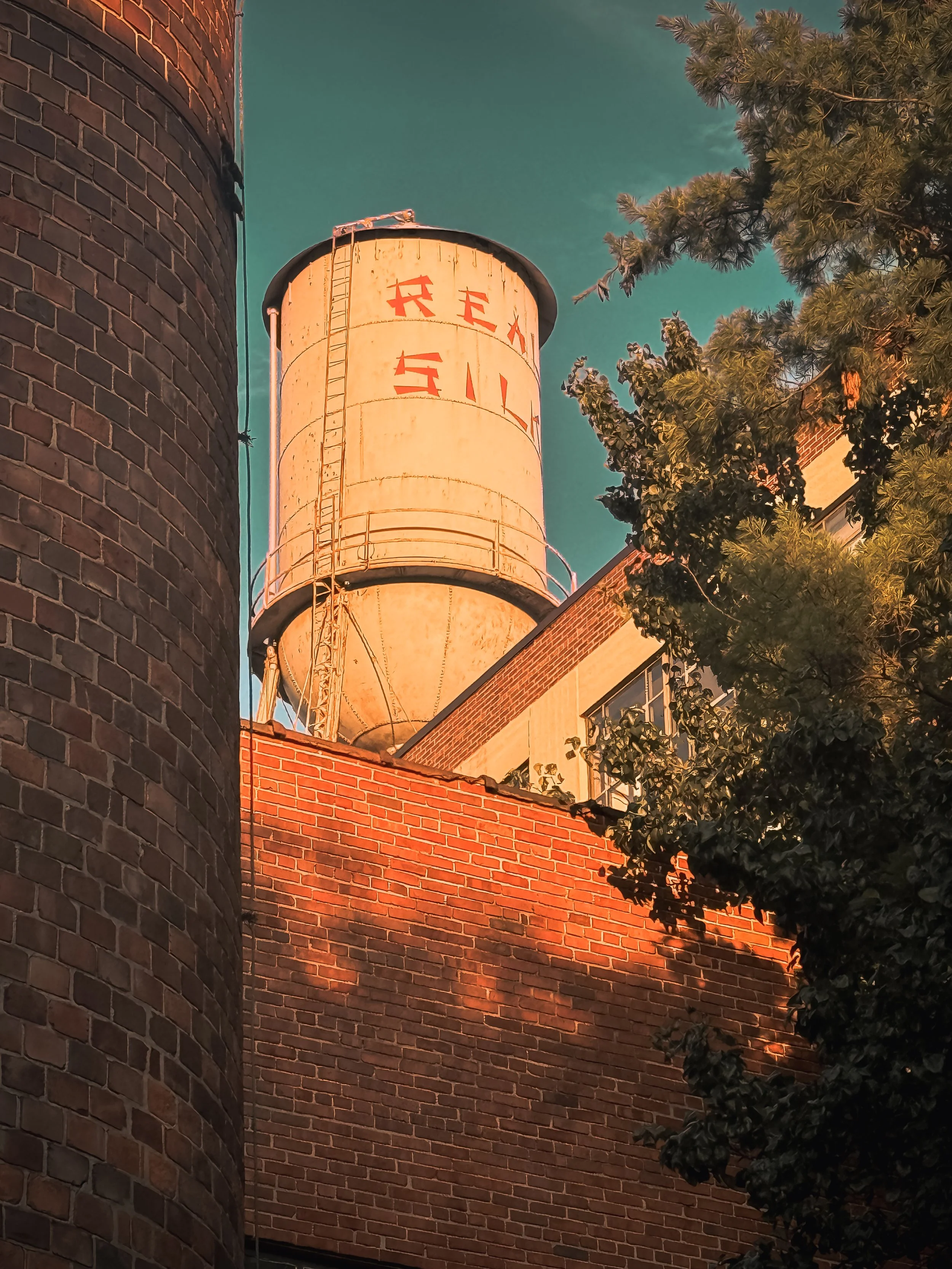
A brick building with a large water tower behind it, surrounded by trees, under a clear sky.

The building still declares its industrial origins. Its long brick elevations, repetitive bays, chimney, and rooftop water tower retain the scale and cadence of a working factory. Along the north wall, five former window openings had been filled with concrete block but remained framed by the original masonry
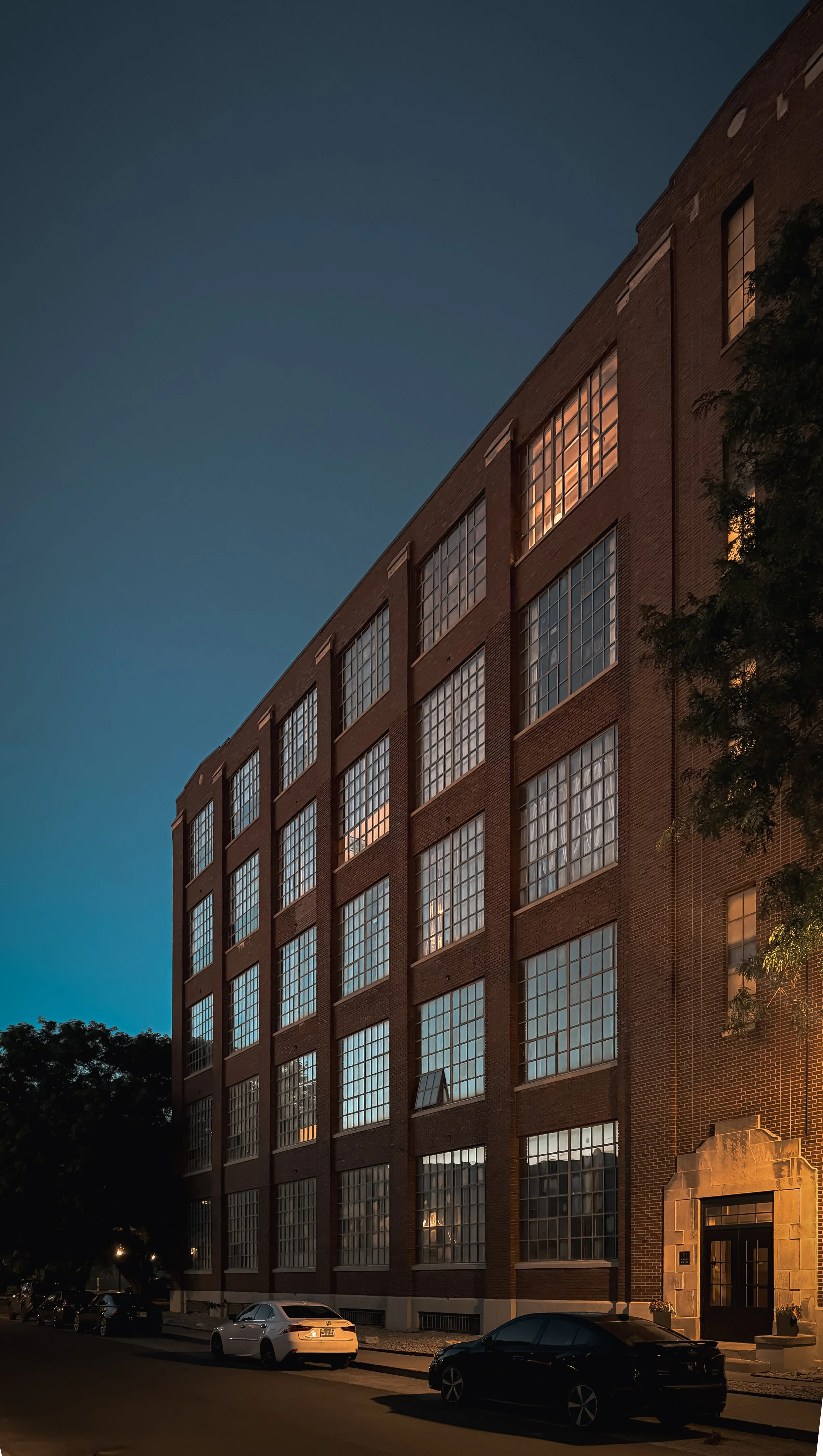
A tall brick building with multiple large windows illuminated from inside, set against a twilight sky. Several parked cars are along the street in front of the building, and trees are visible to the side.
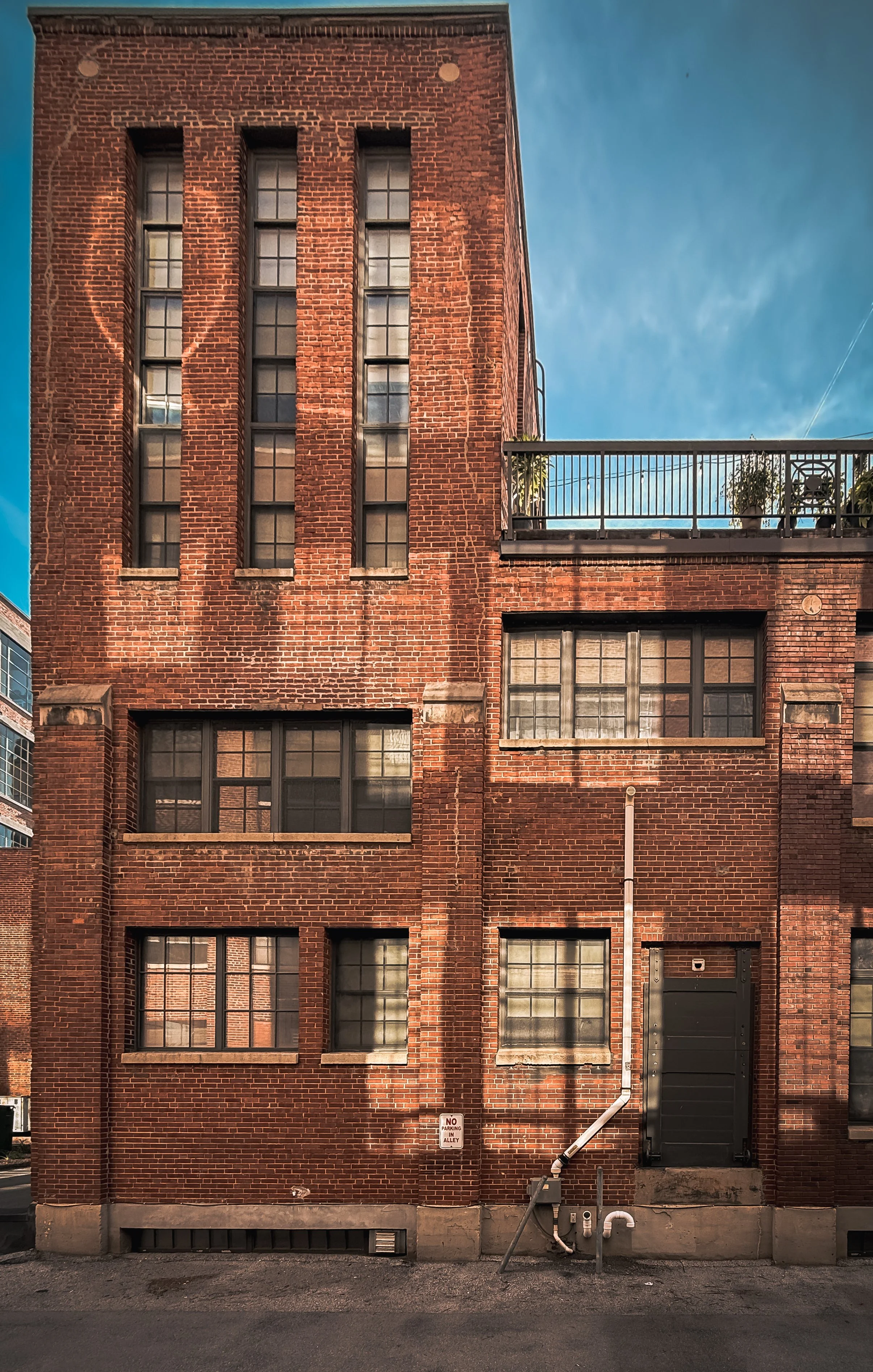
Red brick building with multiple windows, a balcony with potted plants, and a no parking sign on the street in front.

Those five openings became the site of this project. Rather than treating the façade as a blank surface, the commission works within an order the building already possessed: five equal fields, each approximately twelve by fourteen feet. The architecture determined the scale, spacing, and rhythm of the work before the first line was drawn.
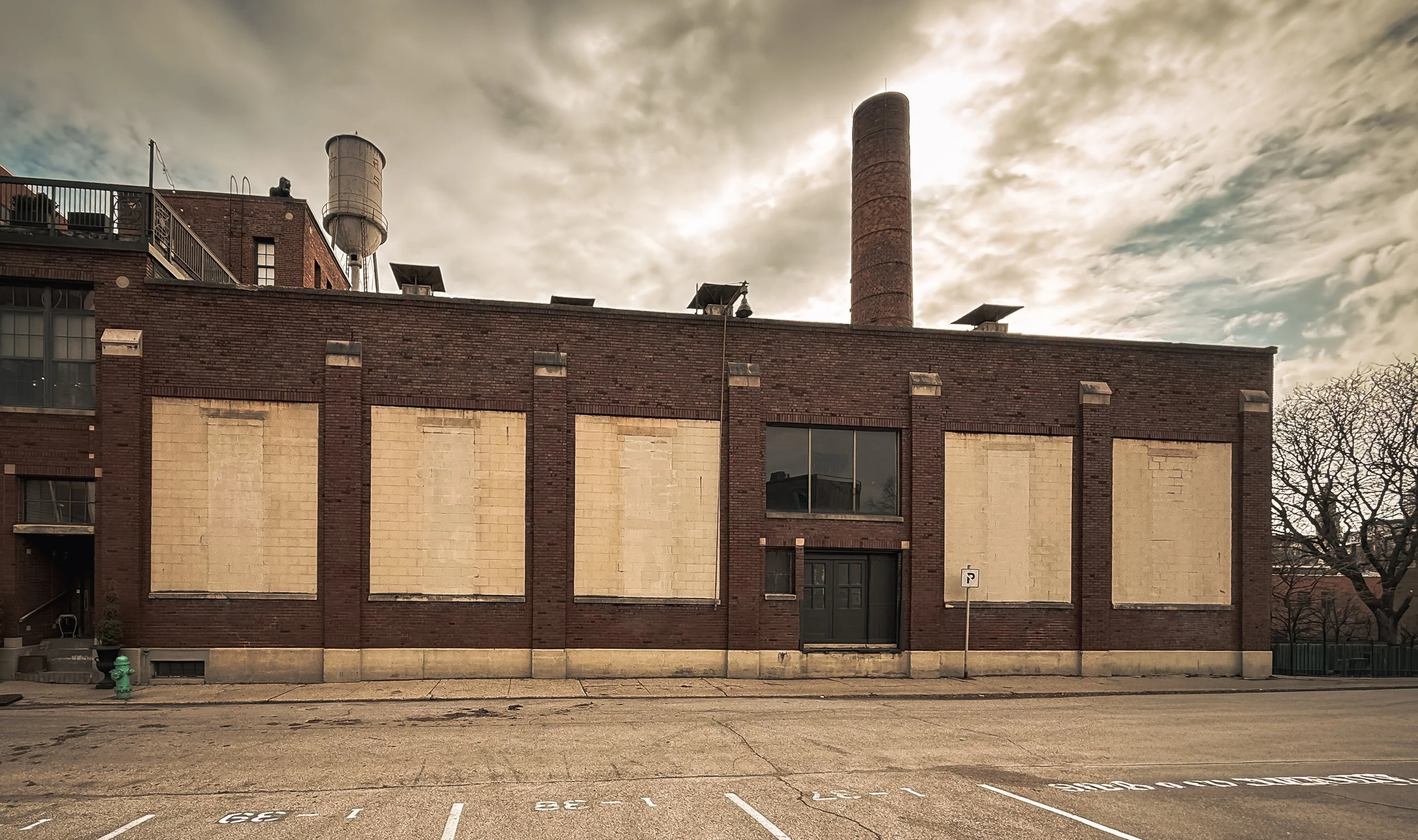
A brick building with boarded-up windows, a storefront door, and a parking lot in front. The building has a water tower and a chimney on the roof, with a cloudy sky in the background.
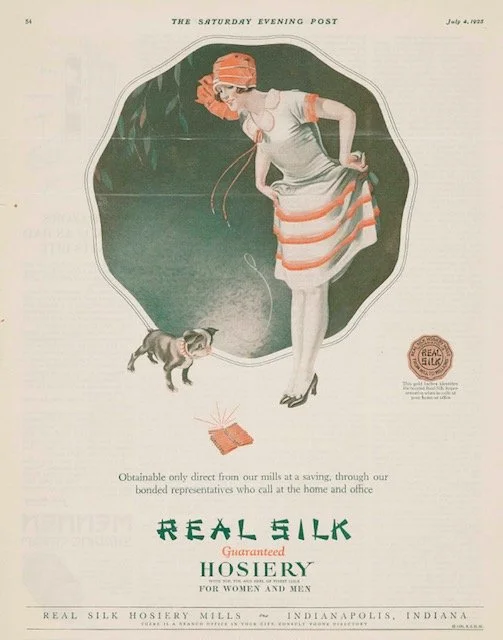
Vintage advertisement for Real Silk Hosiery Mills in Indianapolis, Indiana, depicting a woman with red hair in a striped dress and hat, looking down at a small dog and a spool of thread.

The five murals are drawn from mid-1920s Real Silk advertisements illustrated by Roy Best. An American commercial artist, Best worked across magazine covers, book illustration, portraiture, and calendar art. These images precede the pin-up paintings for which he later became known, but much of that visual language is already present: idealized figures, carefully staged gestures, and an atmosphere of effortless sophistication.

The Advertising Art of Roy Best

Stylistically, the illustrations combine naturalistic figure painting with the economy of commercial design. Softly modeled figures are contained within flat, irregular fields of color; interiors are reduced to a few descriptive objects; and restrained palettes allow posture and silhouette to carry each composition. The work possesses the elegance of the Art Deco period without relying on its harder geometry and remains painterly, intimate, and narrative.
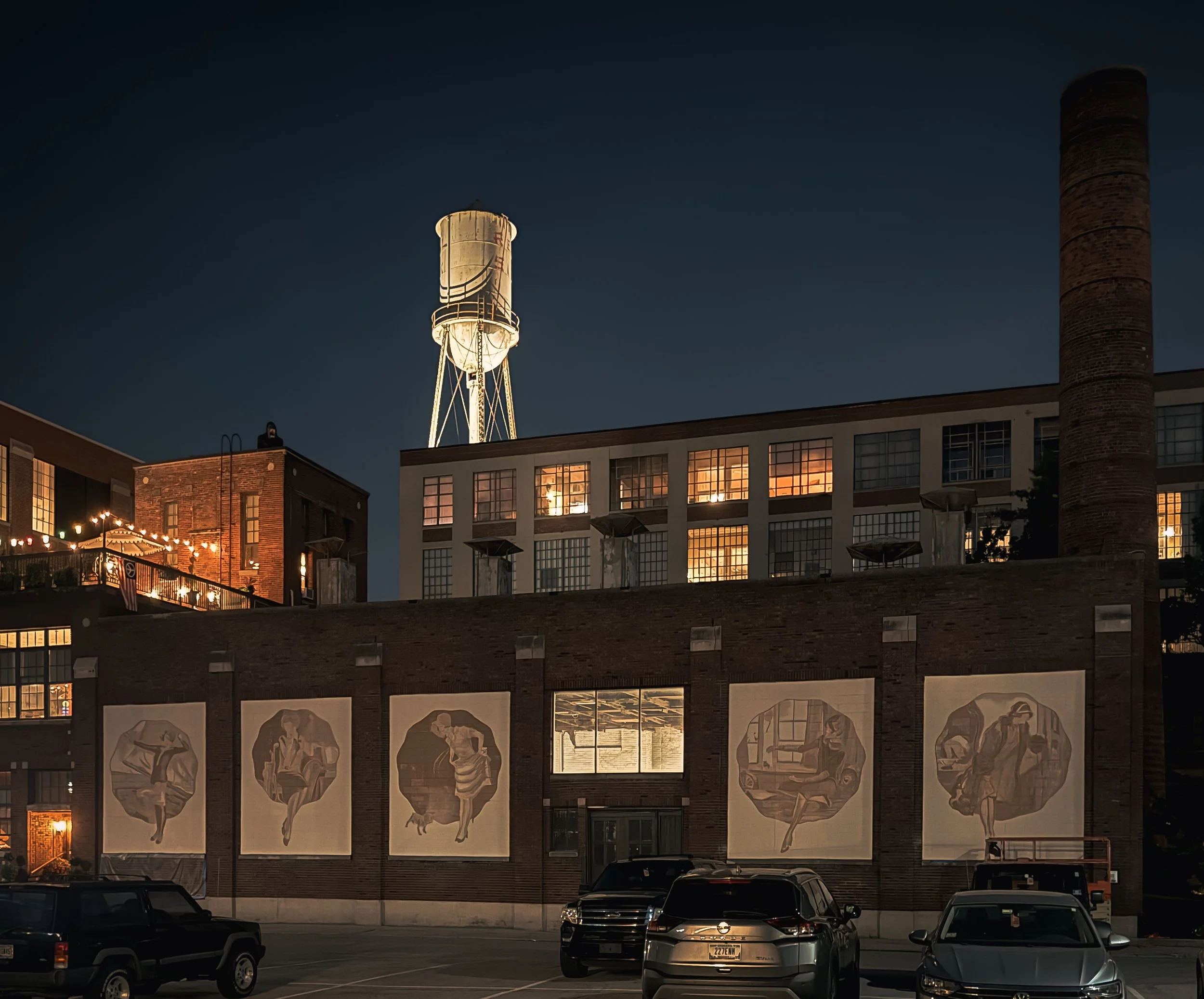
A tall building with an industrial water tower on top, illuminated at night. The building has large windows with lights inside, and the lower part displays black-and-white artwork of people performing various activities.

The Painting Process

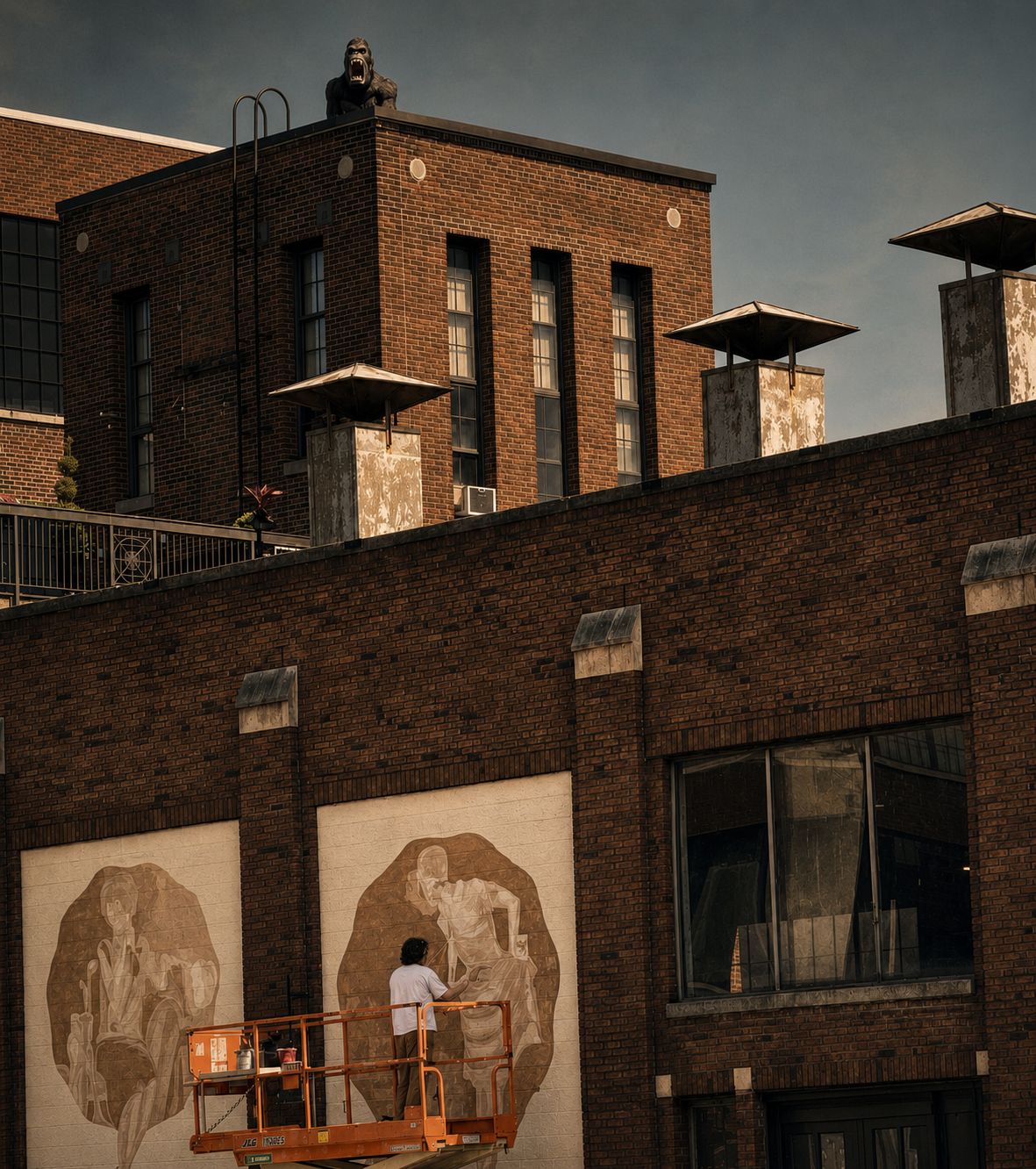
A person painting murals of skeletons on a brick building wall. The person is standing on an orange lift, with a mural of skeletons depicted in earthy tones. In the background, there is a multi-story building with a gorilla sculpture on the roof.

Painting began in sepia tones, establishing the drawing, values, and overall structure of the image.
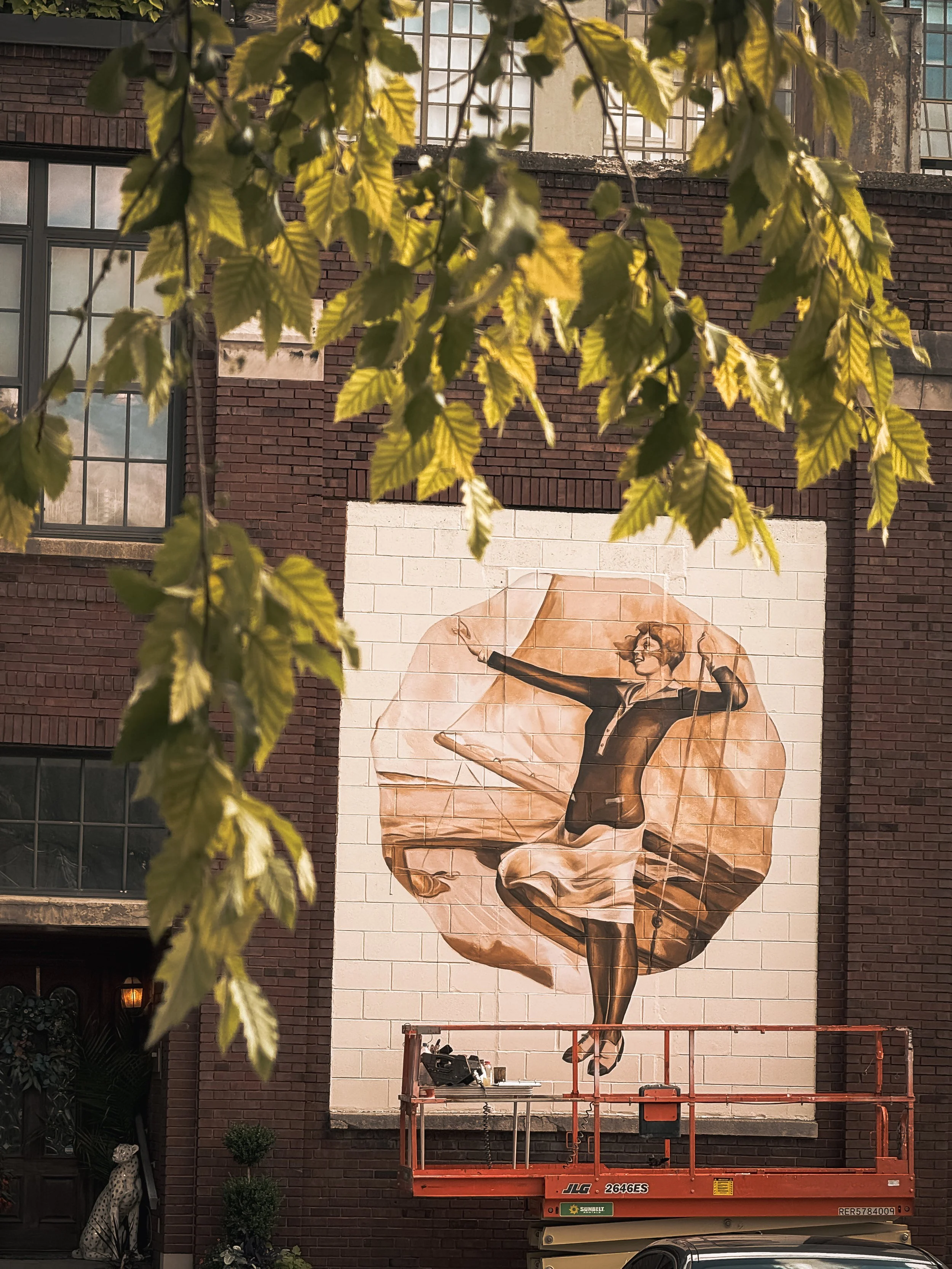
A large mural on a brick building wall depicts a woman in a vintage style dance pose, dressed in black, with a background of a warm, circular glow. A cherry picker is parked below it.

Blue tones were introduced next to deepen the shadows and create the darkest passages without relying on a flat black.
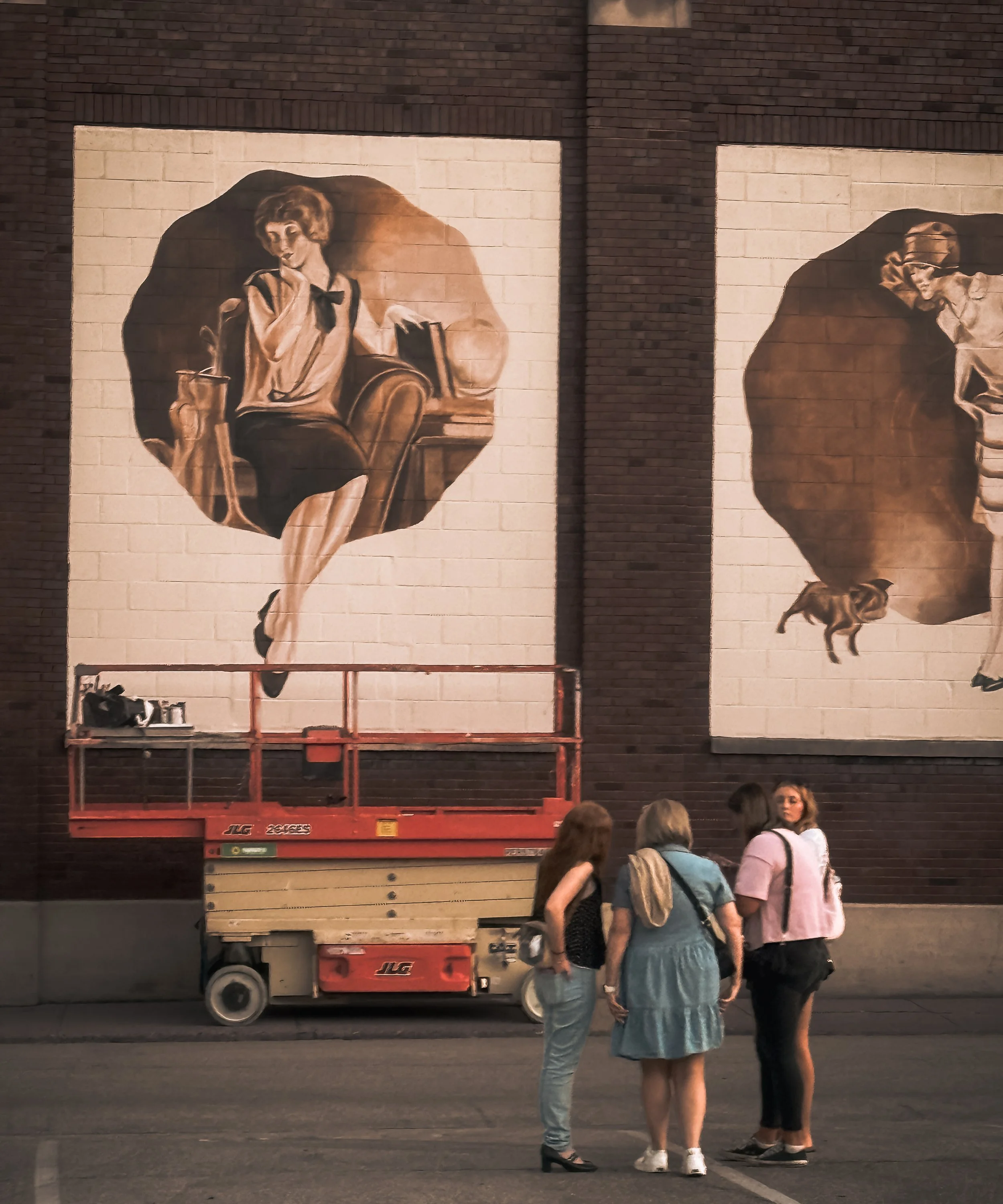
A group of five women standing on the sidewalk in front of a brick wall with two large mural paintings. The murals depict black and white images of women sitting and wearing vintage clothing. One woman in the mural is reading a book, and the other is looking into a camera with glasses. There is a mobility lift parked in front of the murals, and the women are engaging with each other, some looking at the murals and others talking.

Color was then built gradually with layers of transparent pigment rather than blocked in opaquely. The sepia and blue foundations remained active beneath the later color, giving the finished paintings greater depth and tonal variation. Details were refined throughout the process as each layer clarified the figures, clothing, interiors, and surrounding forms.
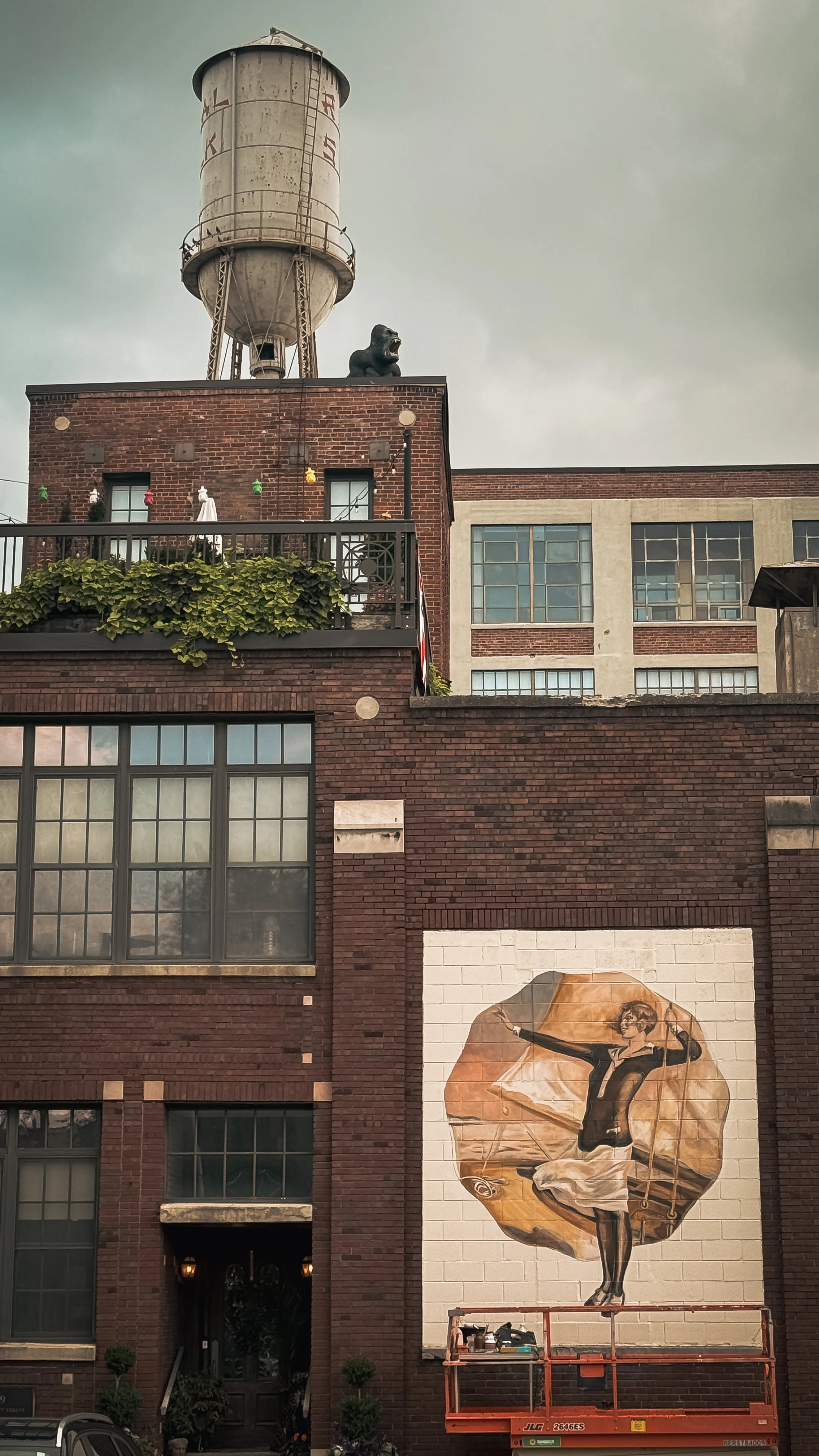
A brick building features a large mural of a woman in vintage attire, holding an umbrella, painted on the lower right side, with a water tower and a lion sculpture on the roof above.

All five murals were developed from the same core palette. Individual colors shift from panel to panel, but their common foundation creates unity across the façade. A final matte protective finish preserves the subdued, antique character of the original illustrations.
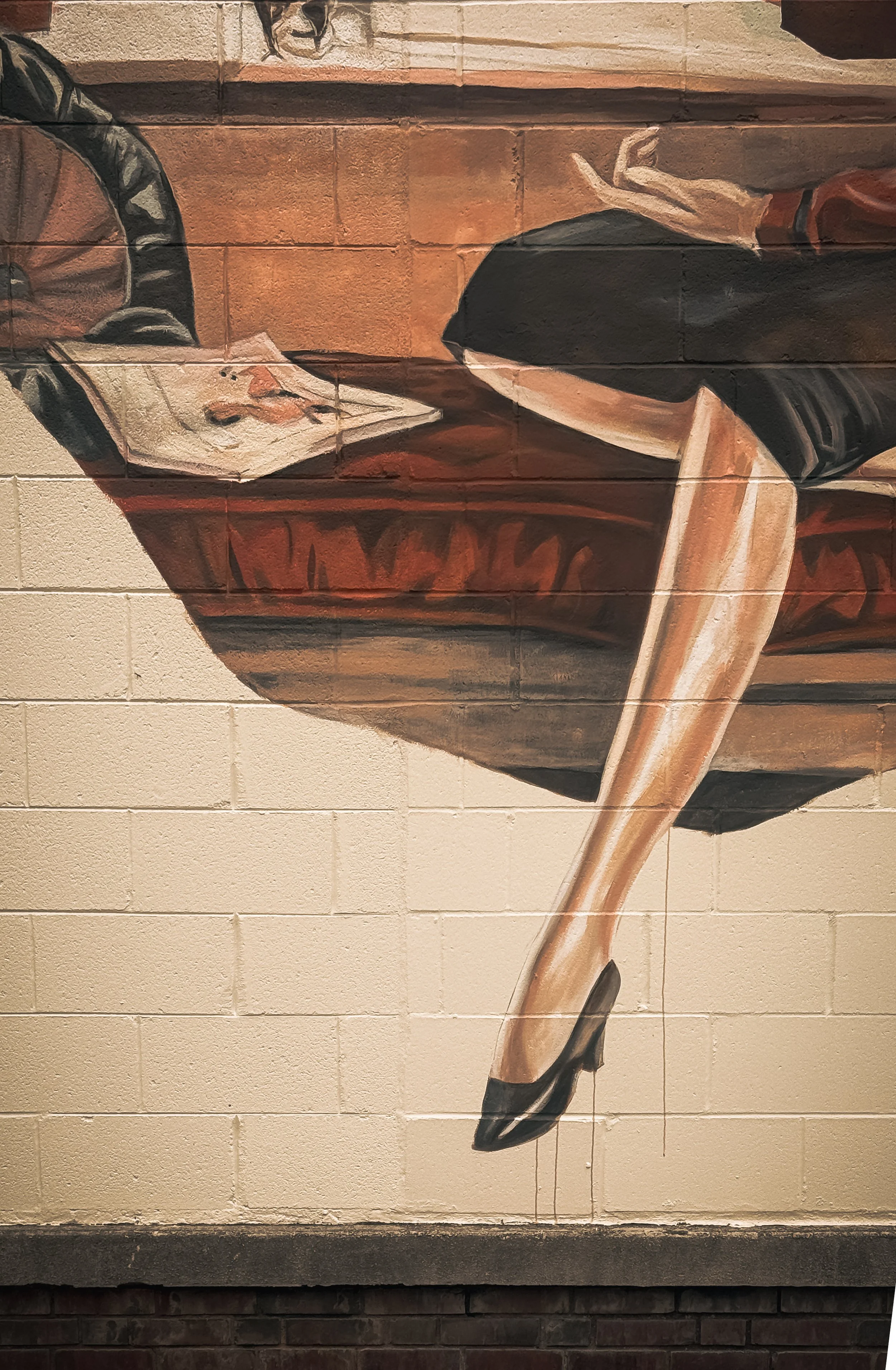
Murale de femme assise portant une robe noire et des talons hauts, tenant un verre dans une main, le visage non visible, peinture murale sur un mur de brique.

Five Murals, One Palette

Each sequence below follows a single panel from its first placement on the wall through successive layers of drawing, value, color, and detail.
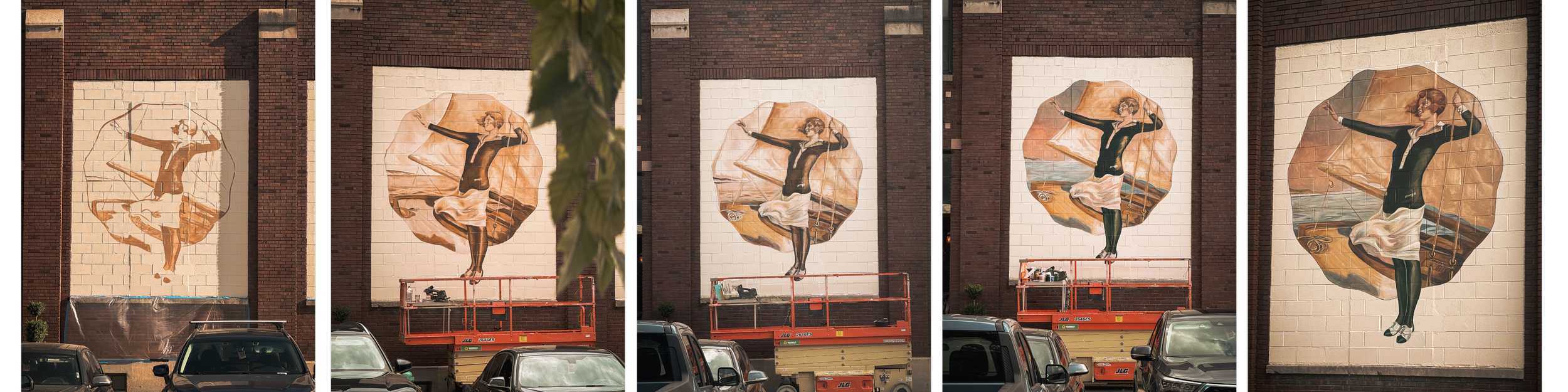
Sequence of five photos showing a mural being painted on a brick wall, depicting a woman in a black top and white skirt balancing on a tightrope, with each photo showing the progression of the painting process.
Pass 01 - placement


The projected composition is transferred to the masonry, and its principal shapes are established in sepia.
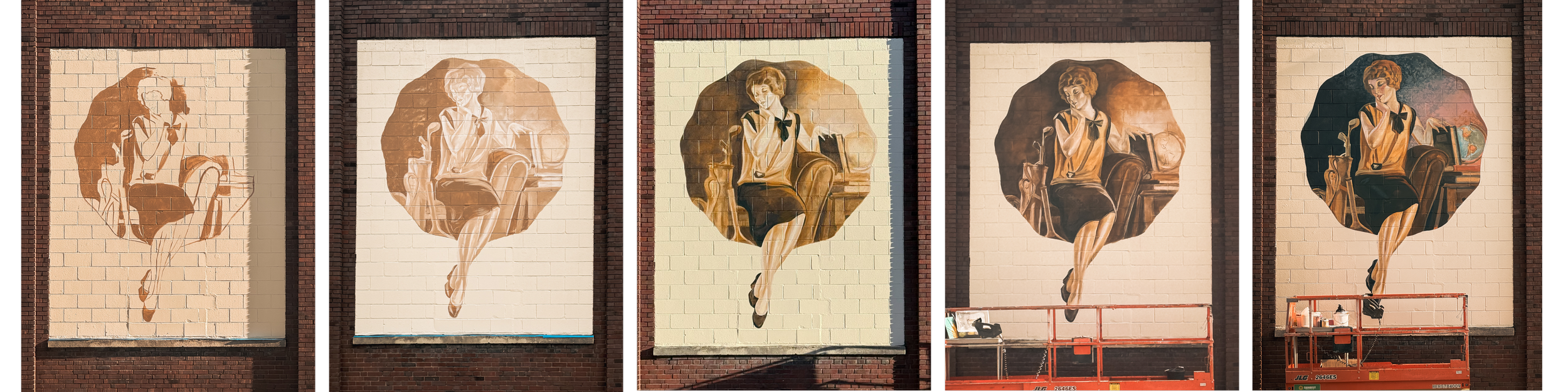
Street art mural of a woman in a yellow blouse and black skirt, sitting on a bench with a book, on a brick wall, depicted in five stages of completion.
Pass 02 - tonal foundation

The sepia underpainting develops the values, forms, and overall depth of the composition.
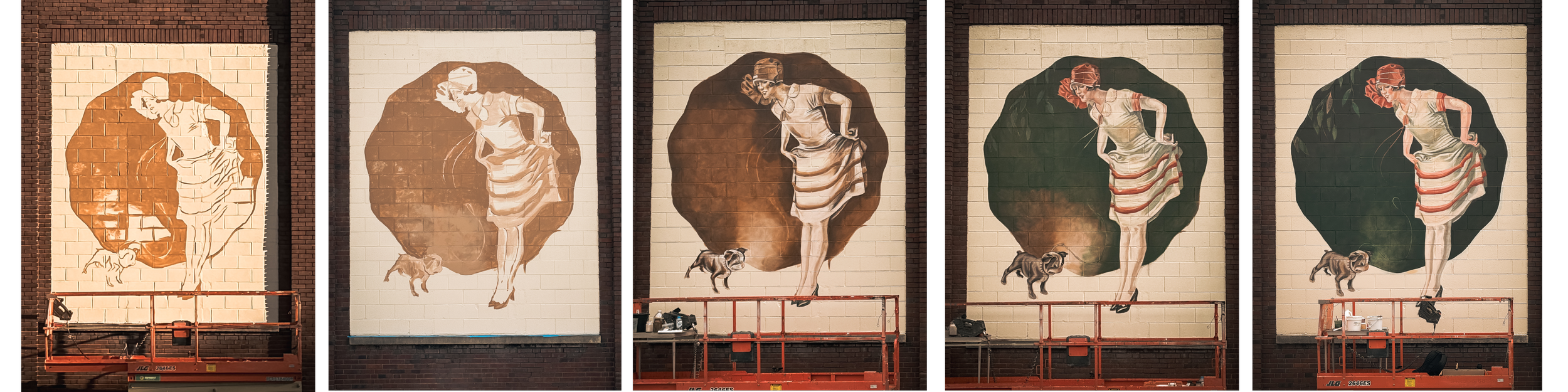
Sequential mural art showing a woman with a dog, gradually colored in darker shades from left to right.
Pass 03 - deepening the darks

Blue tones are layered into the sepia foundation to construct the darkest values without using flat black.
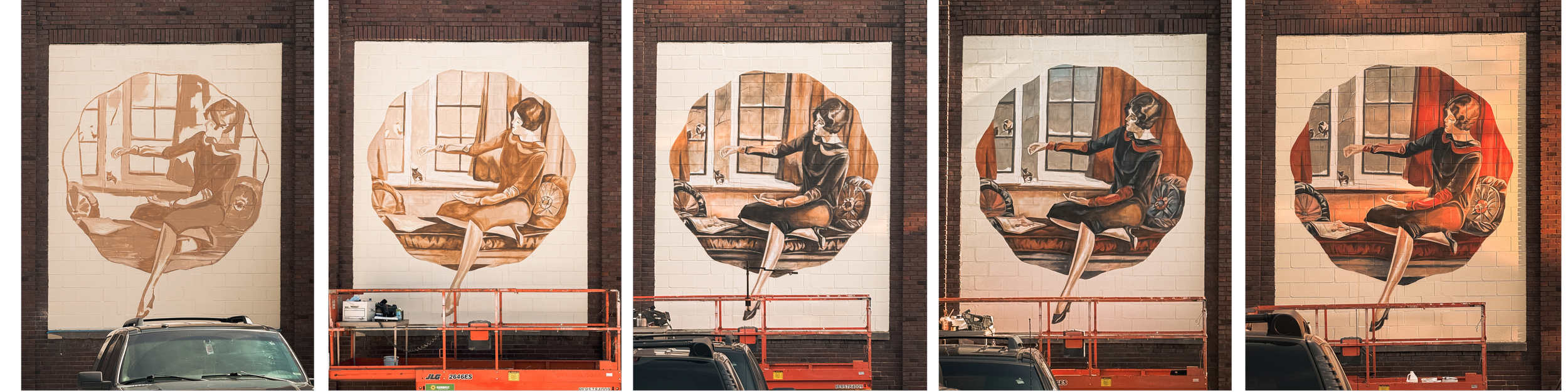
Sequence of five stages of a mural painting of a woman sitting on a chair, painting on a wall, with a car parked below, showing progressive completion of the artwork.
Pass 04 - building color

Transparent pigments gradually build the color while allowing the tonal foundation to remain visible beneath.
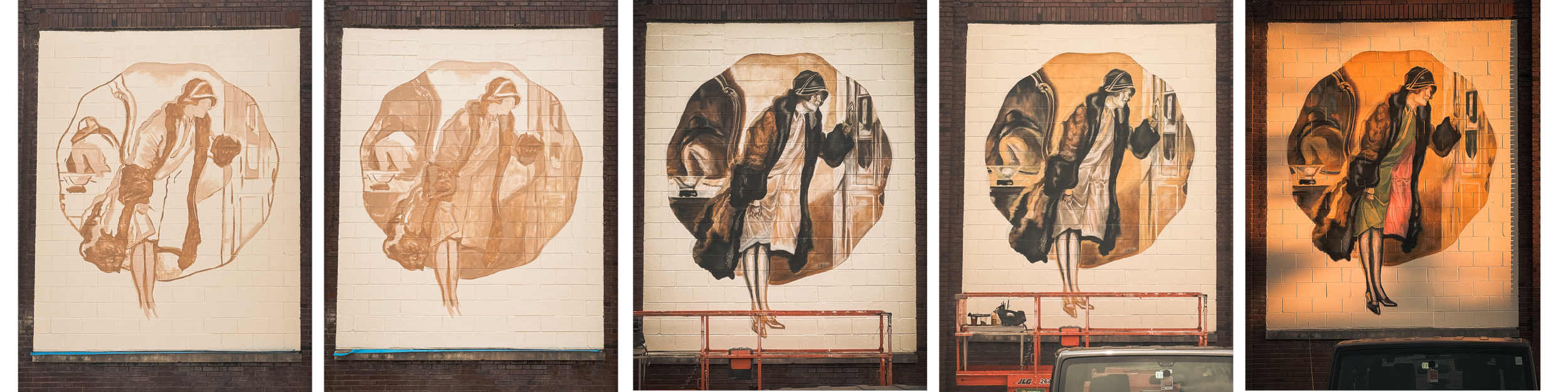
Progression of mural of woman walking, from sketch to finished artwork, painted on a brick wall.
Pass 05 - final refinement

Details, edges, highlights, and color relationships are refined to unify the finished panel.

The Dedication
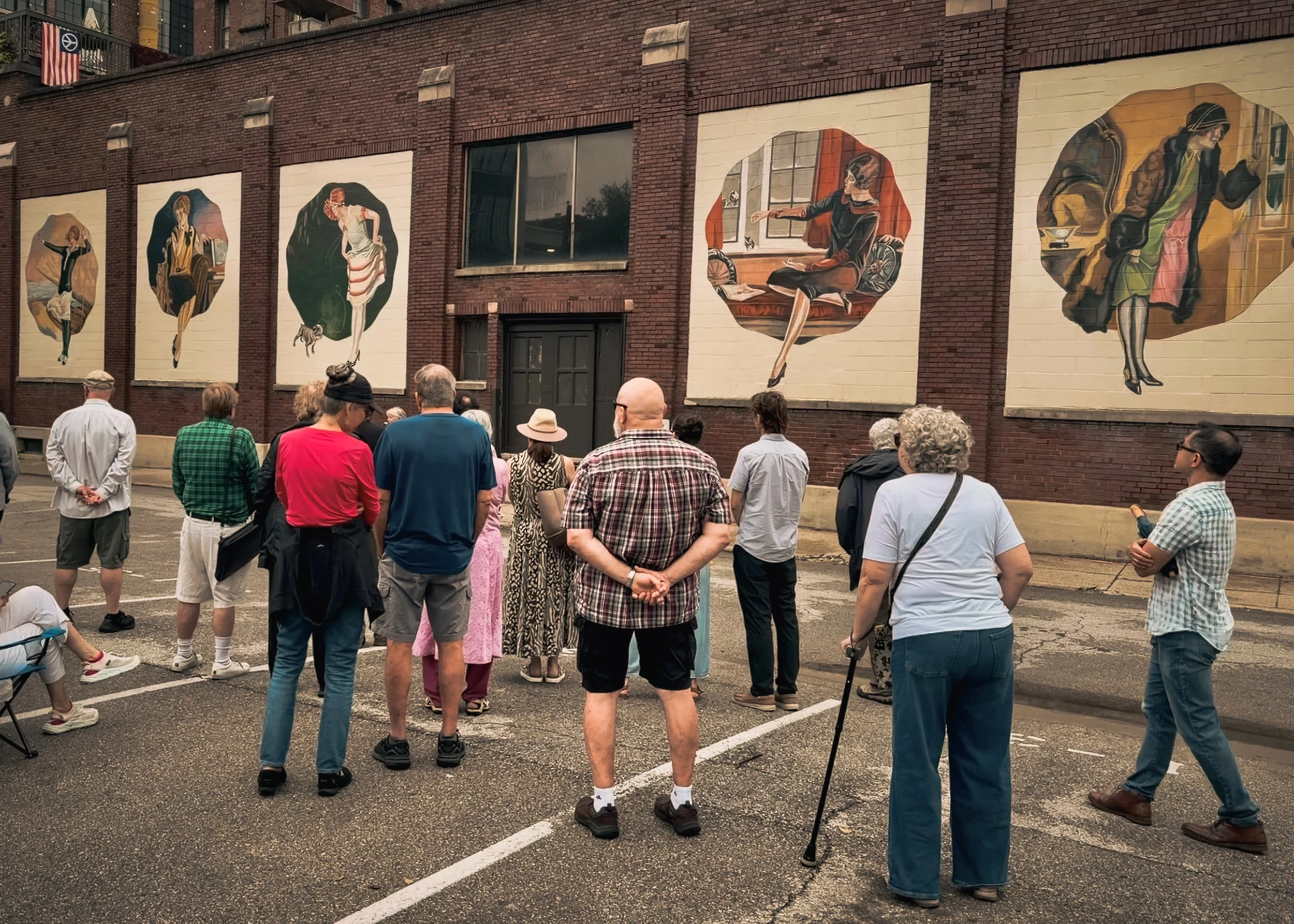
A group of people gathered outdoors in front of a brick building with large murals of women painted on the wall. The people are of various ages and are casually dressed, some are looking at the murals and others are engaged in conversation.

The completed murals were dedicated with residents, project organizers, donors, and neighbors gathered before the north façade. Seen together at full scale, the five panels form a continuous work shaped by the building’s original window bays and unified by a shared palette.
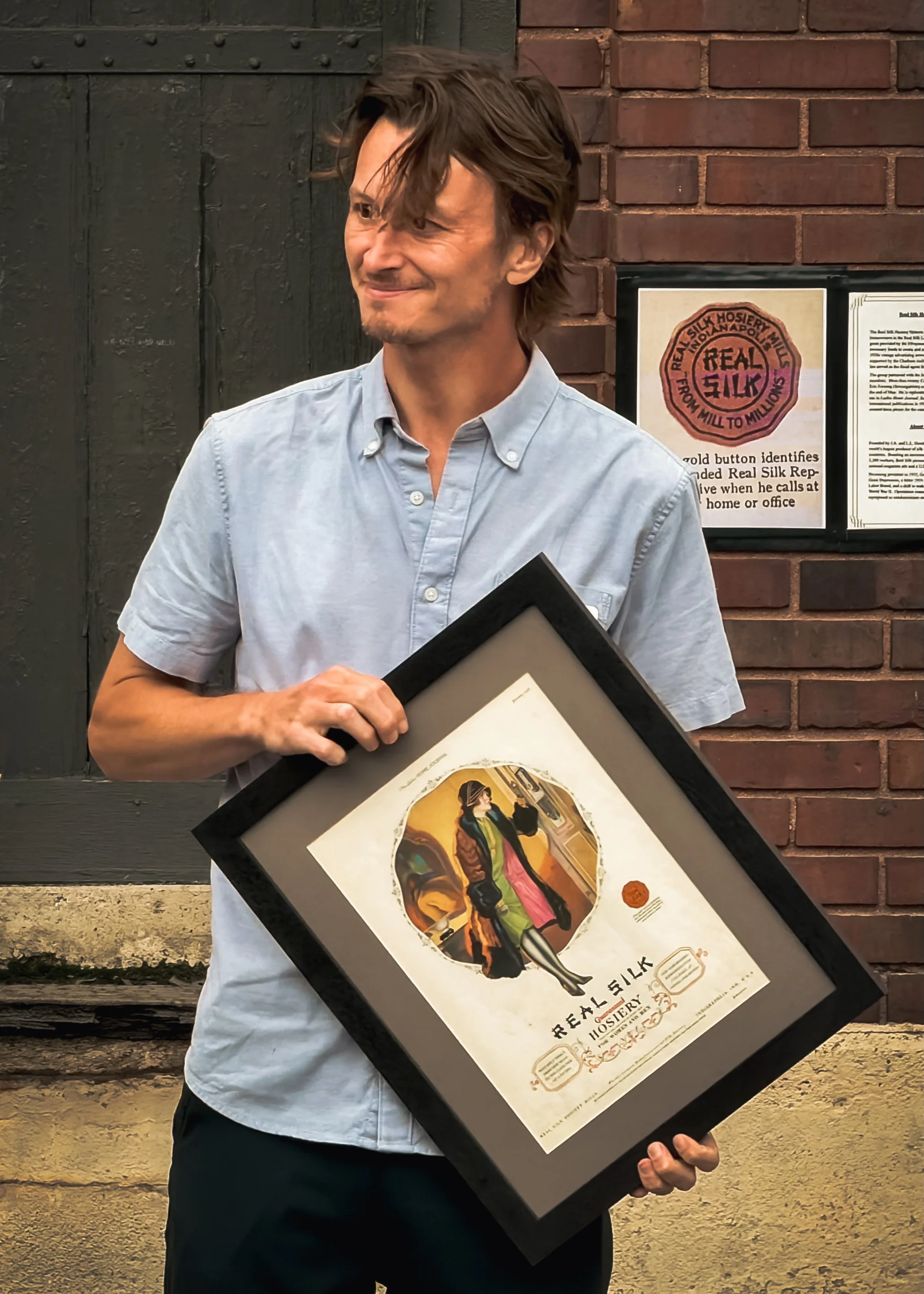
A man in a light blue button-up shirt holding a framed poster in front of a brick wall and black door. The poster features artwork and text related to a whiskey brand, Real Silk Hosiery Mill, with a circular logo and colorful illustration.

During the dedication, the Silk Lofts HOA presented me with a framed original Real Silk advertisement, the source image for the final panel. The gift creates a direct connection between Roy Best’s printed illustration and its fourteen-foot painted counterpart on the building where Real Silk hosiery was manufactured.
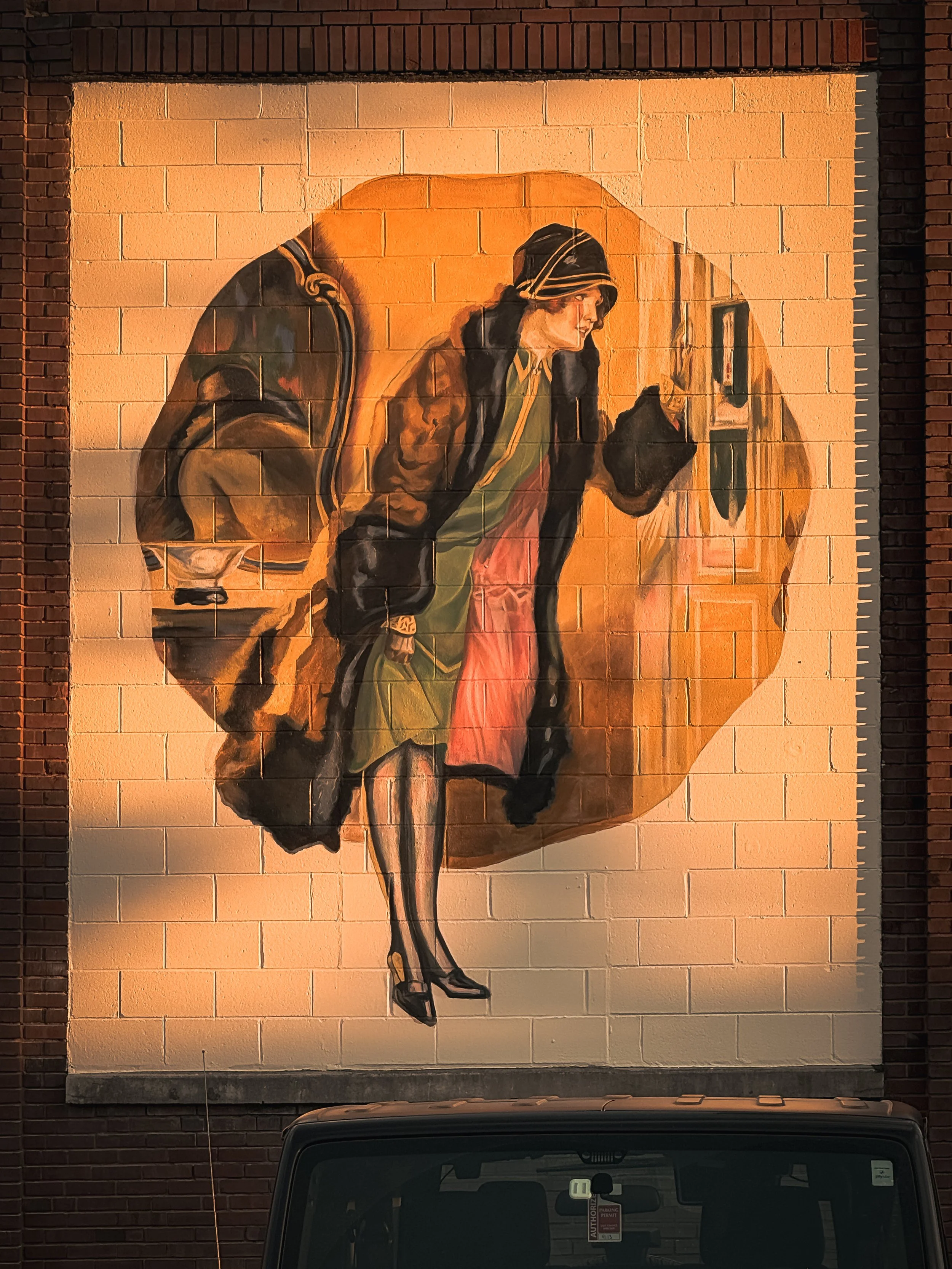
A mural on a brick wall depicting a woman in high heels, wearing a jacket, a green shirt, and red pants, with a reflective surface in front of her.

The commission began with the people who live within the former mill complex. Its dedication marked both the completion of the paintings and their return to the community that made the project possible.
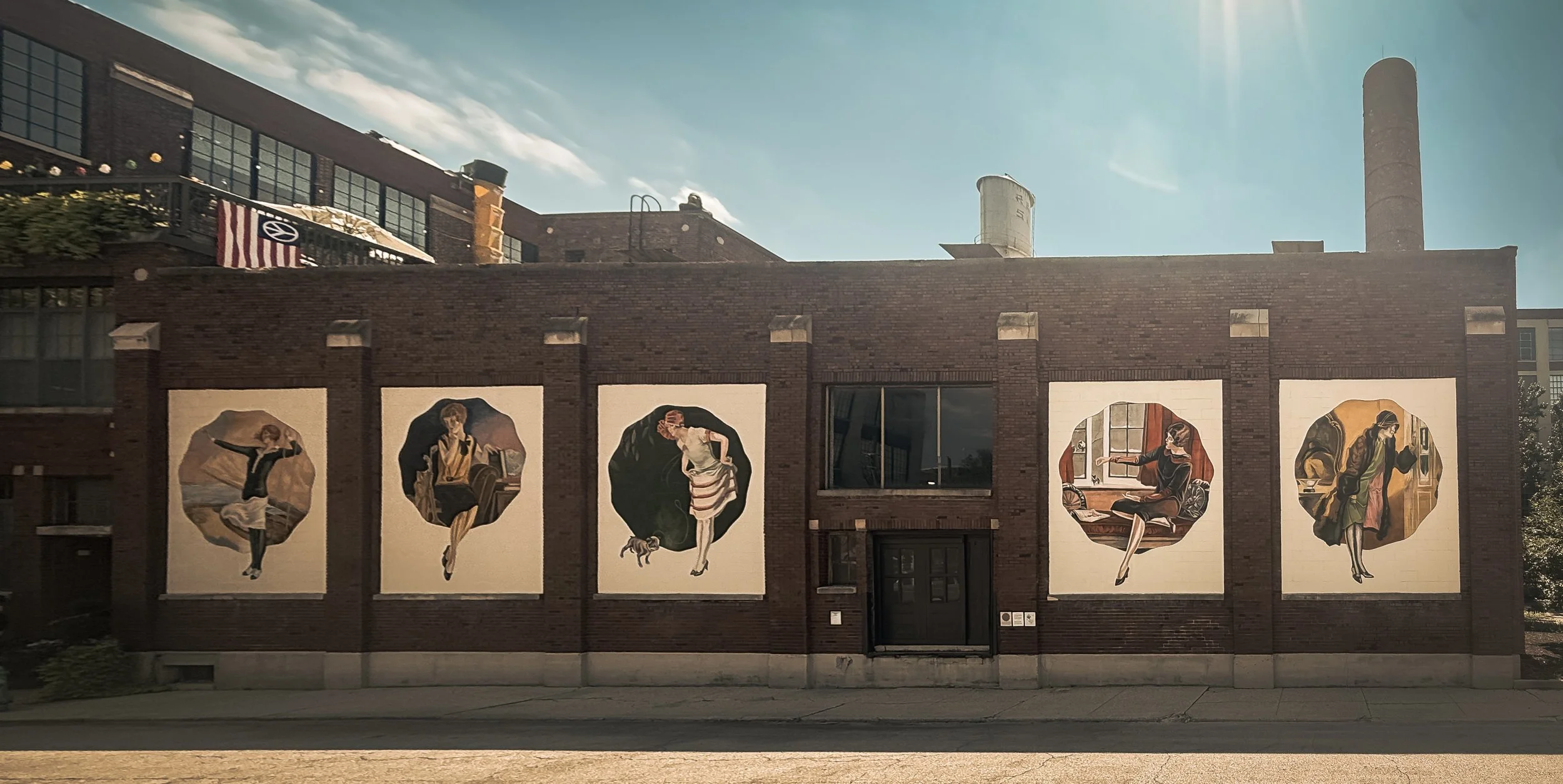
Murals of five women in various poses painted on a brick building wall, with a blue sky overhead.